
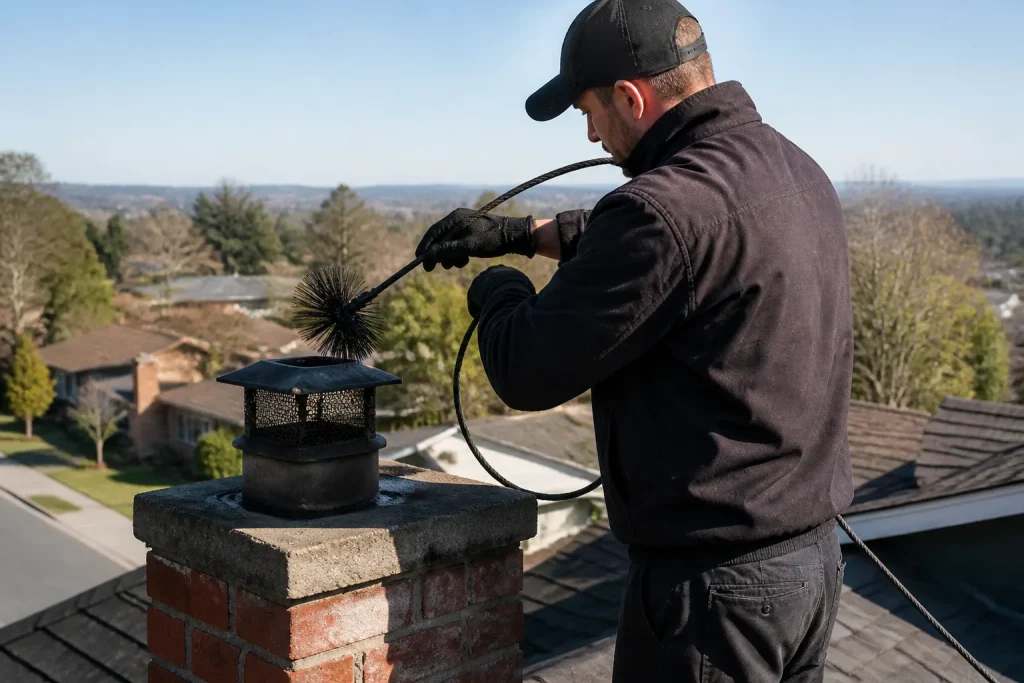
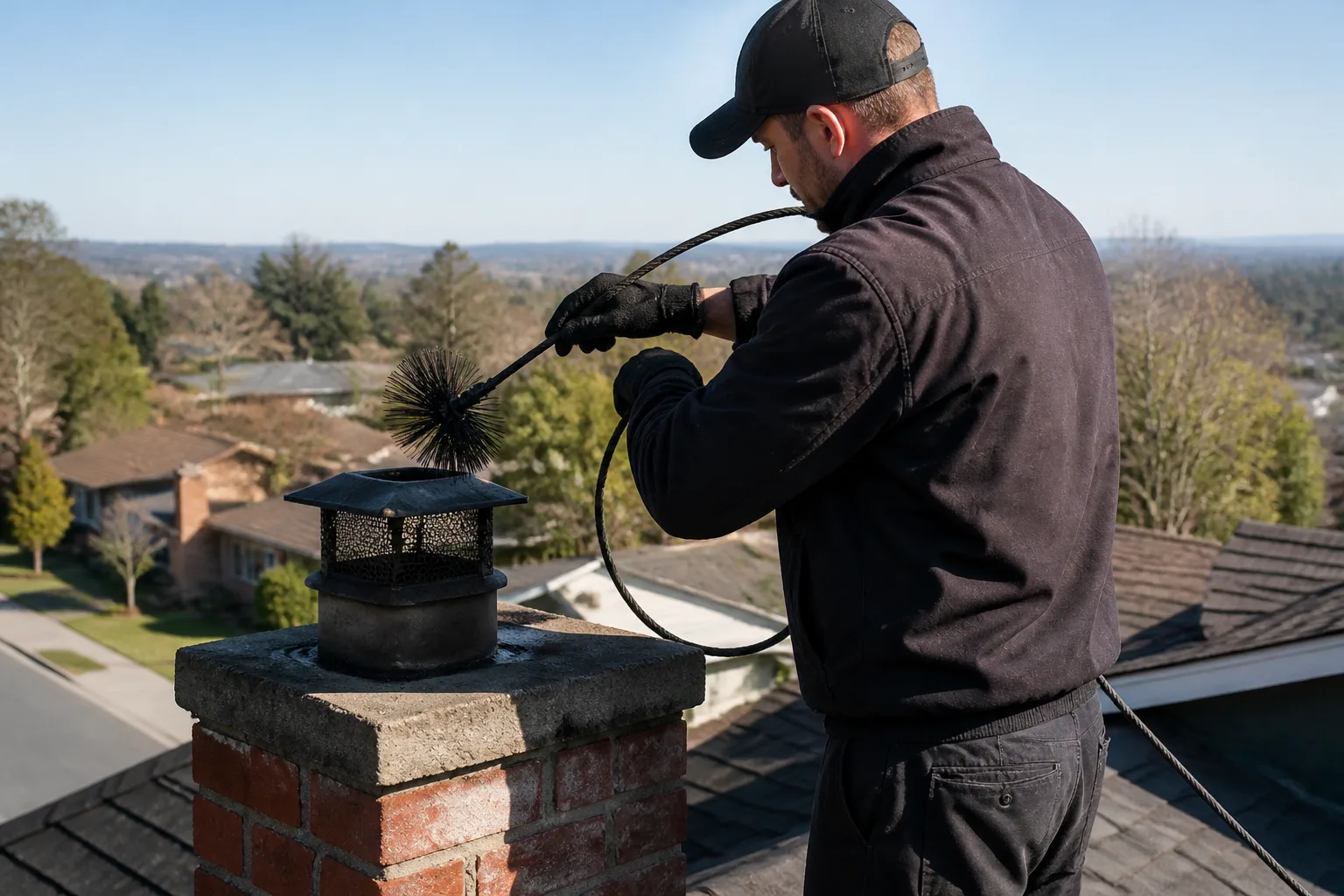
Emergency Chimney Sweep Near Me: What Floral Park Homeowners Should Do First
If you’re searching for an emergency chimney sweep in Floral Park, the first thing to do is decide whether you have an active fire emergency or an urgent chimney problem. Smoke pouring into the room with flames visible outside the firebox means call 911 first, then stop using the fireplace. A strange smell, a scary sound, or smoke that rolls back instead of drawing up is urgent but not immediate – it needs a same-day visit from a chimney specialist. If you’d rather not sort that out alone, call (877) 792-7251 and we’ll help you tell the difference.
The uncomfortable truth about chimneys is that the scariest events are often the quietest. A chimney fire can burn hot enough to damage a flue and then go out on its own before anyone in the living room notices anything. That’s why we treat “emergency” as the window before the disaster, not the disaster itself. This guide walks you through that window step by step, starting with what to do in the first half hour.
How Do You Know If It’s an Active Chimney Emergency or Just Urgent?
Call 911 first if you see flames or glowing material outside the firebox, smell strong burning that isn’t coming from the fire, or see heavy smoke filling the room. Those are signs of a fire that has escaped the firebox or a blocked flue with dangerous backdraft. Get everyone out, then call. Don’t wait to see if it settles down.
An urgent-but-not-immediate situation looks different. These are the calls we get that need a same-day sweep, but not the fire department:
- Smoke rolling back into the room when the fire is lit, especially with the damper open
- A sharp, acrid smell that lingers for hours after the fire is out
- Loud popping or cracking sounds during a burn (the wood itself snaps; the chimney shouldn’t)
- Creosote flakes or dark soot falling onto the hearth
- A weak or lazy draft that used to be strong
- Visible staining or dark streaks on the outside of the chimney breast
Here’s the honest part: most Floral Park homeowners we talk to who describe one of these signs have been noticing it for two or three weeks. That pattern matters. A chimney doesn’t usually go from perfect to dangerous in a day. It goes from fine to poor draft to partial blockage to a fire over a season. Catching it in the “poor draft” stage is a lot cheaper than catching it in the “dark streaks on the outside” stage.
The other thing to know is that gas fireplaces and inserts can look fine for years. A gas appliance that starts making a strange smell or burning with a different flame color deserves the same urgency as a wood-burning problem. Carbon monoxide doesn’t announce itself.
What Should You Do in the First 30 Minutes?
Close the damper, stop adding wood, and get the fire out safely – then wait, and leave the diagnostics to a specialist. Here’s the sequence, in order:
- Stop feeding the fire. Don’t add wood, don’t try to “burn it out” of whatever is stuck in the flue. Let it die down.
- Close the damper once the fire is visibly out. This slows airflow through the chimney and helps contain any smoldering creosote. But if smoke is actively backing up into the room, opening a window in that room (not next to the firebox) helps clear the air.
- Get people and pets out of the room. Even a minor backdraft throws fine soot into the air, and fine soot is not something anyone should be breathing in a closed room.
- Don’t run a fan pointed at the fireplace. This is the mistake we see most often. A fan near the firebox pushes air into a space that’s already struggling to draft, and it can send smoke and carbon monoxide deeper into the room.
- Don’t open windows right next to the firebox. A strong cross-breeze can reverse the chimney’s natural draft and pull smoke into the house instead of up the flue.
- Note what you saw. Time, smell, sound, whether flames or smoke appeared outside the firebox, whether the smoke alarm went off. Write it down while it’s fresh. What you remember at 9pm when the technician arrives will be less clear.
After that, pick up the phone. We answer 24/7, and a call outside dispatch hours is booked into the next opening, Sunday through Friday, 7am to 7pm. If you’re in Floral Park and the chimney has done something alarming, ask for a same-day visit and describe what you saw. That description determines what we bring and how soon we need to be there.
Why Does Calling a Handyman in a Panic Often Make Things Worse?
A generalist handyman can sweep a chimney. What a generalist usually cannot do is tell you whether the flue liner is still sound, whether the crown is shedding water into the masonry, and whether the firebox is showing signs of a past overfire. Those are the parts of the system where an “emergency sweep” turns into a real problem.
A chimney is not just a tube. It’s a working system of firebox, flue, damper, crown, cap, and masonry shell, and each part affects the others. A handyman who sweeps the flue and pronounces it clean has checked one part of six. A chimney specialist checks all of them, which is why our chimney sweep always includes an inspection of the crown, cap, and damper along with the flue. We see the aftermath of “just sweep it” jobs often enough to know how quickly a small crack becomes a masonry problem.
The other risk of a panic call to a generalist is materials. Most handymen don’t carry HeatShield or DuraFlex systems, because those are specialty liner products. If the problem turns out to be a cracked liner or a damaged crown, the generalist isn’t going to fix it – they’ll tell you to call a chimney company anyway, and you’ve lost a day. In Floral Park, that lost day is often the difference between a chimney repair and a chimney rebuild.
When you call a chimney company, ask two questions: do you inspect the full system, and what brand products do you install? The answers tell you a lot. We work with HeatShield and DuraFlex because the repair has to hold for seasons, not weeks. Gelco and Olympia Chimney components are on the same list.
What Hidden Damage Does a Chimney Fire Leave Behind?
A chimney fire can leave the flue liner heat-fractured in ways you cannot see from inside the firebox. That’s the single most underappreciated part of a chimney emergency, and it’s why a firebox look isn’t a diagnosis. The firebox is the part you can see. The flue is the part that carries the fire.
What we look for after a suspected chimney fire:
- Hairline cracks and spalling in the liner. These often appear as vertical lines or small missing flakes, and they can be invisible from the firebox but obvious from the top of the chimney.
- Warped or discolored dampers. A damper that has warped has been exposed to heat well above normal operating temperatures, which usually means the flue above it needs a close look.
- Glazed or glassy creosote. This is the hard, shiny creosote that forms when a fire has burned hot enough to fuse the deposits. It’s not the fluffy kind, and it’s not something a standard sweep can remove without the right tools.
- Cracked or displaced crown. A chimney fire can heat the top of the structure enough to crack the crown. That crack lets water in, and water plus masonry plus cold weather is a repair waiting to happen.
- Staining on the outside of the chimney. Dark streaks on the exterior are evidence that heat or moisture has been working through the masonry.
HeatShield ceramic resurfacing is one of the tools we reach for here. It’s a proprietary system that restores the liner’s surface without a full replacement, and it’s a good fit for a liner that has lost integrity but hasn’t failed structurally. DuraFlex flexible liner systems are the other path – they reline a flue that’s beyond resurfacing. A chimney cap & crown visit is often part of the same job, because water intrusion is the second act of most chimney fires. Fix the fire damage and leave the crown cracked, and you’ll be back to a repair in two seasons.
What Should You Have Ready Before the Technician Arrives?
Photos, any recent inspection reports, and a written note of what happened will save time and lead to a more accurate diagnosis. The more the technician knows before stepping onto the roof, the better they can plan the visit and the less back-and-forth you’ll deal with on the day.
Put together:
- Photos from outside and inside. Shots of the chimney from the ground, the firebox, the damper, and any dark streaks or staining on the chimney breast.
- Any recent inspection report. Even an old one tells the technician what the chimney looked like before the event.
- Notes on the event. What you saw, heard, and smelled, and when.
- The history of the last burn. What you were burning, how long ago you had it swept, whether you noticed anything odd while lighting it.
- Access notes. Where the attic hatch is, whether the roof is reachable, and whether any pets will need to be moved.
In our experience, a homeowner with photos and a clear timeline gets a more precise estimate from the start. Our technicians have up to 10 years of experience reading chimneys, and even they’ll tell you that a good set of photos from the homeowner is worth fifteen minutes of roof work.
Before you call, ask yourself one honest question: is the chimney part of your home’s heating system, or is it part of its safety system? The answer changes what you’re willing to accept in a repair. A chimney isn’t a decoration. Your family doesn’t get a second flue.
When to call a pro: if you smell anything unusual after a fire, if smoke won’t go up, if you’ve had a chimney fire (even a small one), or if it’s been longer than a year since your last sweep. The signs don’t have to be dramatic to be urgent.
Related services in Floral Park: we also offer fireplace repair if the firebox itself needs work, and a full chimney inspection as part of every visit. If you’re not sure what you need yet, start with a Chimney Sweep Floral Park sweep and inspection.
How Often Should You Sweep to Avoid a Real Emergency?
Sweep once a year if you burn wood regularly, and inspect the system at the same time. That rhythm catches the warning signs two or three visits before an emergency has a chance to develop. If you burn occasionally, once a year is still the floor, because a flue can sit idle for months and still be full of last winter’s creosote.
Floral Park’s mild winters make this easier to forget than in places with long heating seasons. A fireplace that runs a couple of evenings a week has a flue that looks clean and a lining that doesn’t. That’s why we treat the annual sweep as a starting point, not an endpoint. A chimney sweep without an inspection is a cleaning. A sweep with an inspection is a diagnosis. The diagnosis is where the value is.
Homeowners in Floral Park who call us after a first alarm of smoke, smell, or sound are usually relieved to hear that the problem is on the “cracked crown” end of things, not the “rebuild the chimney” end. The message is simple: catch it early. The visit costs less, the repair costs less, and the chimney lasts the next season and the next decade.
If you’re in Floral Park and want to know what the chimney is doing before the season starts, we answer 24/7. Fast dispatch from 7am to 7pm, Sunday through Friday. A call outside dispatch hours is booked into the next opening.
The Bottom Line
The warning window is where chimney emergencies actually start. Most begin not with a fire in the room but with a smell, a sound, or a smoke rollback that’s easy to talk yourself out of. The steps above are the sequence we’d recommend to any Floral Park homeowner: call 911 if it’s active, close the damper and stop feeding the fire if it’s urgent, don’t run a fan near the firebox, gather photos and any inspection report, and call a chimney specialist who can diagnose the full system instead of sweeping one part of it.
We’ve written this to be useful whether or not you end up calling us. But if you’re in Floral Park and need help, Chimney Sweep Floral Park offers free estimates – call (877) 792-7251. We answer 24/7. Fast dispatch from 7am to 7pm, Sunday through Friday. A call outside dispatch hours is booked into the next opening.
Frequently Asked Questions
It can usually wait if there’s no smoke, smell, or sound – a standard annual sweep is not an emergency. Call now if you’ve had a chimney fire, if smoke backs up into the room, if you smell strong burning hours after the fire is out, or if dark streaks appear on the outside of the chimney. Call (877) 792-7251 for an exact quote – estimates are free.
Sweep and inspection pricing varies by the flue, the creosote level, and whether the visit is same-day. The written estimate sets the price, so you know the number before anyone gets on a roof. Call (877) 792-7251 for an exact quote – estimates are free.
Yes. A chimney fire can reach temperatures hot enough to damage a flue and go out on its own, sometimes before anyone in the house smells smoke. The damage it leaves behind – heat fractures in the liner, a warped damper, glazed creosote – is often invisible from the firebox. That’s why we inspect from top to bottom, not just the firebox.
Call 911 first if flames or glowing material appear outside the firebox, if heavy smoke is filling the room, or if you smell burning that isn’t coming from the fire itself. Call a chimney sweep for anything urgent but not immediate: smoke rollback, weak draft, unusual smells, or a suspicious sound. If you’re not sure which it is, call (877) 792-7251 and describe what you saw – we’ll help you sort it out.
Written by the team at Chimney Sweep Floral Park.
Need Chimney Cleaning Help?
Call Chimney Sweep Floral Park - the local pro we connect you with is licensed and insured, with free written estimates in Floral Park.
(877) 792-7251